When a Novel Becomes a Film, What Can Stay the Same?
When a novel becomes a film, compare how it carries the central conflict across changes in narration, chronology, and access to a character’s thoughts.
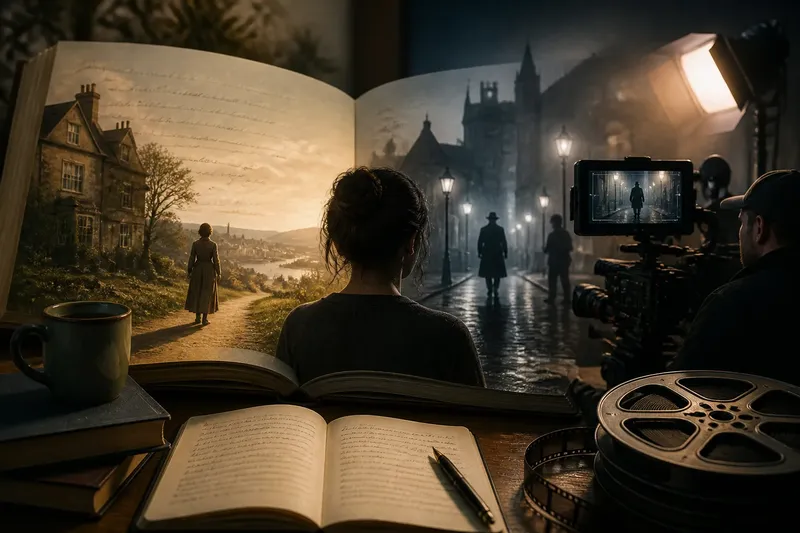
The most common mistake in judging a novel-to-film adaptation is treating every changed scene as a broken promise. That approach misses what matters: when a novel becomes a film, its central conflict can survive even if narration, chronology, or access to a character’s thoughts changes. The cost of overlooking that distinction is mistaking a different storytelling method for a different story.
A novel can explain what a character fears while showing an ordinary errand; a film has to make that fear legible through performance, sound, framing, or an altered event. The useful question is not whether every page made it onto the screen, but what kind of continuity the film has chosen to protect.
Conflict as the anchor
Start by naming the conflict in plain language. It might be a daughter’s desire to leave a family business against her parent’s need to keep it alive, or a detective’s pursuit of truth against the cost of exposing someone vulnerable. Focus on the opposing pressures, not on a list of plot events.
Then ask whether the film keeps those pressures active. The characters may meet in different places, reach decisions in a new order, or express themselves less openly. If their choices still press against the same opposing needs, the adaptation may preserve the novel’s central dramatic structure while changing its route.
This distinction helps explain why a film can omit a memorable episode yet feel faithful, or reproduce a scene almost word for word yet feel emotionally remote. An episode matters to the adaptation when it carries a pressure, relationship, or choice that the rest of the story cannot easily replace. Familiar wording alone cannot do that work.
Three adaptation approaches
Adaptations often lean toward one of three approaches. They can preserve a novel’s explanatory voice, translate its inner life into film language, or rebuild the story’s structure around a different rhythm. These are not strict boxes; a film may use more than one, but identifying its dominant approach makes comparison clearer.
Keep the narrator audible
A film can retain narration through voice-over, diary entries, letters, or spoken recollection. This suits novels whose narrator has a distinctive personality or whose account is itself part of the conflict. A narrator who edits, misunderstands, or withholds information is not merely delivering background; the gap between what is said and what appears can shape the audience’s judgment.
The risk is that voice-over can repeat what an image already communicates. It works best when the spoken account adds a particular perspective, complicates the visible action, or gives the film access to a voice that the scene cannot carry on its own. When it only names an emotion the actor has already made clear, the narration can flatten rather than deepen the moment.
Translate thoughts into film
A film can remove the narrator and give inner life a visible or audible form. A pause before an answer, a glance toward an unopened letter, a sound that returns at a tense moment, or a close framing that isolates a face can suggest thought without stating it. This approach suits novels whose emotional movement matters more than the exact words used to describe it.
Translation is not a secret code with one correct gesture for each sentence. The film can let a viewer infer what a character wants from behavior and context, while leaving some uncertainty intact. That can preserve the novel’s emotional pressure without pretending that a camera can simply record a thought.
Rebuild the chronology
A film can rearrange events, combine characters, or move information earlier or later. This approach suits novels with a sprawling cast, long stretches of reflection, or a revelation whose original timing does not fit the film’s pace. A changed order can keep the central conflict active while making the audience encounter it differently.
The important comparison is what the new order changes in the audience’s understanding. If a film reveals a secret sooner, it may shift attention from “What happened?” to “What will this knowledge do to the relationship?” The plot information stays, but the dramatic question changes. That can be a deliberate adaptation choice rather than an accidental loss.
Where did the thoughts go?
Can a film preserve a character’s inner life?
It can preserve the pressures and contradictions of that inner life without translating each thought into dialogue. Look for patterns in what the character notices, avoids, repeats, or cannot bring themselves to say; those choices can give behavior a legible inner direction.
Does voice-over make an adaptation more faithful?
Voice-over preserves a form of narration, but it does not automatically preserve the narrator’s effect. Ask whether the voice changes how the images are understood, reveals a bias, or controls what the audience knows; if it only recites visible events, its presence may be mostly cosmetic.
Is a rearranged plot still faithful?
It can be, if the new order retains the conflict and gives the changed sequence a clear dramatic purpose. Compare what the characters stand to lose and how their choices reshape that risk, rather than treating the novel’s sequence as the only possible structure.
Compare the right things
A fair comparison separates three layers: events, information, and dramatic pressure. Events are what characters do. Information is what the audience learns, and when. Dramatic pressure is the conflict pushing a character toward a choice. A film may alter the first two while preserving the third—or may keep the events but change the pressure by revealing a motive sooner.
Imagine a novel in which a teacher hides a student’s letter while deciding whether to protect the student or expose a serious betrayal. In an invented film adaptation, the letter might appear in the opening scene, before the teacher knows who wrote it. The film could then use restrained performance and delayed identification to keep the same conflict alive, while replacing the novel’s private narration with uncertainty about what the teacher suspects.
To read a particular adaptation, choose a scene where the character faces a consequential decision. Compare the novel and film by asking:
- What does the character want in this moment?
- What opposing need or obligation stands in the way?
- What information does the character have, and what does the audience know?
- Does the film state the character’s thought, show it through behavior, or leave it uncertain?
- Has the sequence changed, and what new question does that order create?
- Does the changed scene still lead to a choice with comparable emotional consequences?
Think of adaptation as moving a story between containers: the same object may fit, but its shape determines how it can be carried. A narrator’s explanation may become a look, an exchange of objects, a silence, or a sound cue. The container matters because it decides what the audience can notice, not because one form is inherently more truthful.
Choose your comparison lens
If you value a novel’s voice, begin with narration. Notice whether the film keeps the narrator’s attitude, shifts it into voice-over, or removes it and gives the audience a less guided view. This lens is especially useful when the narrator’s reliability or personality affects the story’s meaning.
If you care most about character, follow access to thought. Choose a scene with a difficult choice and track how the film communicates hesitation, desire, or self-deception. This lens suits adaptations where the novel spends substantial time inside one person’s mind and the film has to make that pressure observable without turning it into explanatory dialogue.
If the novel’s structure is your main interest, compare chronology and the order of revelations. Mark where each version tells you what happened, then ask how that timing changes suspense, sympathy, or the meaning of a decision. This is the best lens for stories built around withheld information or a character’s changing understanding.
For a balanced judgment, use the conflict as your anchor and pick just one of those lenses for a close comparison. That keeps the discussion specific without demanding that a film reproduce every feature of a novel. When asking what can stay the same, the strongest answer is often the struggle a character must face; voice, order, and access to thought are the choices that let each medium make that struggle its own.