A Doorway in the Frame: Reading Entrances in a Scene
Learn how to read doorway entrances in film scenes by tracking framing, movement, and who gains control of your attention when someone arrives.
The common mistake in reading a doorway entrance is to watch only the arriving character. That can hide the cost of the entrance: a shift in attention, a changed relationship between people already in the room, or a sudden loss of control over the frame. To read doorway entrances in film scenes, notice what the shot asks you to look at before anyone crosses the threshold—and what changes once they do.
A doorway is more than a route into a room. It divides space, creates a visible boundary, and gives a director a simple way to arrange who can see whom. Use these seven cues to follow how an entrance redirects a scene through blocking and framing.
Find the frame’s first focus
Before the entrant appears, identify the shot’s strongest point of attention. It might be a face in close-up, a pair of figures across a table, or a patch of empty space framed by the open door. That first focus is the scene’s starting balance—not necessarily an equal one, but the arrangement the entrance may disturb.
Then check whether the doorway is already visible. If the camera includes it from the start, the entrance may be anticipated, even if the character has not arrived. If the door sits outside the frame, the arrival can feel more abrupt because a voice, shadow, or movement at the edge may make you look beyond the existing composition.
Ask yourself who holds your attention before the threshold is crossed. A character speaking in the foreground may seem to control the room, while a listener farther back watches the door. The later entrance can confirm that quiet attention or overturn the apparent hierarchy.
Track the threshold crossing
Follow the entrant’s movement from approach to arrival. Does the person pause in the doorway, enter without hesitation, or remain partly hidden behind the frame? Each choice makes the threshold read differently. A pause can turn the opening into a point of decision; a direct crossing can make the arrival feel like an interruption.
Notice what happens to the camera during the crossing. It may stay fixed and let the character move through the composition, pan to follow, or cut to a new angle. A static camera lets you compare the entrant’s movement with the positions already established. A pan transfers attention with the person, while a cut can make the arrival feel like a fresh beat.
Look for small physical reactions as well as the main movement. Someone may stop speaking, shift a chair, turn only their eyes, or block the entrant’s path. These responses show that the entrance has altered the room before any dialogue explains what the arrival means.
Read the doorway within the frame
Framing controls how much importance the entrant receives. A wide view can place the person among the room’s existing relationships; a tighter view can isolate the arrival and make it compete with the people inside. Neither approach has a fixed meaning. The useful question is how the framing compares with the shot just before it.
Watch the doorframe’s position and shape. A character centered in the opening may appear visually prominent, while someone placed near its edge can seem less settled or more exposed. A narrow strip of doorway can also divide the entrant from the group, holding them in a separate visual space even after they have come inside.
Look at the space above and around the entrant. An open area can give the arrival visual weight; a crowded composition can make the person seem absorbed into an existing group. The frame works like a picture frame: it does not merely contain the action but directs attention toward particular relationships within it.
Compare depth and distance
A doorway often reveals several planes at once: a near foreground, the room where the main action takes place, and a space beyond the threshold. When an entrant appears at the back of a deep composition, watch whether the people in front remain sharp and visually dominant or whether the newcomer draws the image’s attention despite the distance.
Depth can make an entrance feel gradual. The character may cross a hallway, approach through a second room, and arrive at the group without a cut. In another scene, the entrant may suddenly fill a close shot. The contrast between these choices matters: one lets you observe the person joining the existing arrangement; the other makes arrival the immediate subject.
Pay attention to whether anyone moves closer to the newcomer. If people remain planted while the entrant crosses the room, the newcomer has to negotiate the group’s space. If a person approaches the doorway, that movement can look like welcome, confrontation, or an attempt to control the encounter, depending on what the scene has established.
Watch the group’s blocking
Blocking is the placement and movement of performers within the scene. Once the entrant arrives, compare everyone’s position with the arrangement before the entrance. A person who turns toward the door may temporarily leave another character without a partner in the composition. A group that closes ranks can make the newcomer seem excluded; a gap in the formation can offer a clear place to join.
Track who changes position first. The entrant may stop at the edge of the room and wait, or someone inside may stand and meet them. That difference assigns initiative: one person is asking for access, while the other is choosing whether to grant it. Watch whether that first move changes the positions of anyone else.
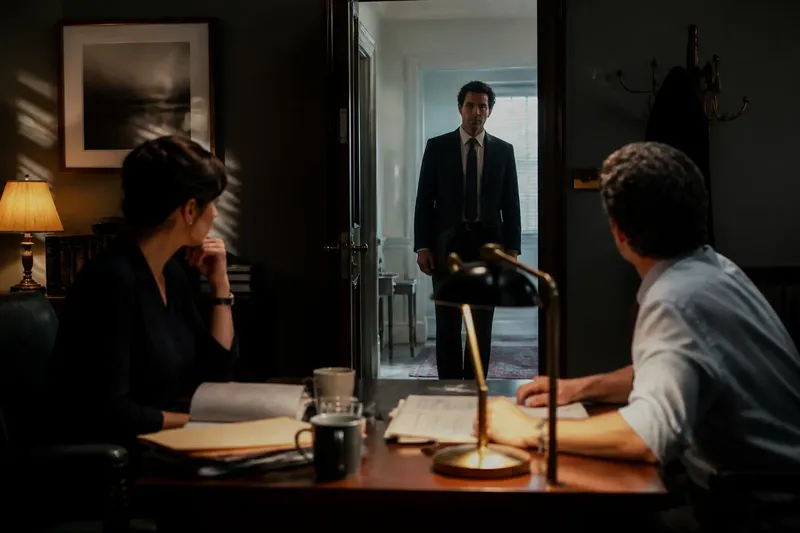
For an invented situation, imagine two colleagues facing each other across a desk while a third person enters carrying a folder. If both colleagues turn toward the doorway, their conversation loses its visual center and the entrant briefly becomes the scene’s shared focus. If only one looks up while the other keeps reading, the same arrival divides their attention and may sharpen the difference between them.
Notice sightlines and obstruction
Ask who can see the doorway and who cannot. A character with a clear view may notice the entrant before the others, creating a brief gap between what one person knows and what the group has registered. The camera can emphasize that difference by showing the watcher’s gaze, the opening, and the arrival in a connected sequence.
Obstruction matters too. A door, a foreground figure, or the edge of a wall can partly hide the newcomer. The audience may see less than the characters, or more. When someone inside looks toward a space that the camera withholds, the unseen area becomes part of the scene’s tension without needing a new location.
After the entrant crosses the threshold, check whether the group’s sightlines settle into a new pattern. A character may now face the newcomer with their back to someone else. The entrance has not simply added a person; it has changed who can address, monitor, or ignore whom.
Read what happens after entry
The meaning of an entrance often becomes clearer after the crossing. Does the camera hold on the newcomer, return to the person who was interrupted, or include everyone in a wider composition? The next shot can establish whether the arrival has taken command, been absorbed into the group, or left the old conflict intact.
Listen for the relation between movement and dialogue. If a character speaks while still in the doorway, the words may accompany a refusal to enter fully. If the person crosses first and speaks afterward, the movement can establish presence before the dialogue claims attention. Sound can also announce an offscreen arrival through footsteps or a door before the image reveals the person.
Finally, compare the scene’s balance before and after the entrance. The group may return to its earlier positions, but the moment can still have changed what each person knows or notices. A useful viewing note is simple: name the initial focus, describe the entrant’s route, and record which character gains or loses the strongest position in the final composition.
Questions about doorway entrances?
What does a doorway symbolize in a film scene?
It can suggest a boundary, an invitation, an obstacle, or simply a route between spaces. Read the meaning from the character’s behavior and the scene’s framing rather than assigning the doorway a universal symbol.
How can a camera make an entrance feel sudden?
The camera may keep the door outside the frame, cut directly to the entrant, or hold on the room until movement or sound draws attention to the edge. The effect depends on what the shot has already led you to expect.
What is blocking during a doorway entrance?
Blocking is how performers are positioned and moved in the scene. During an entrance, it includes where the newcomer stops, who turns or moves, and how those choices reshape the group’s arrangement.
Should I focus on the entrant or the people inside?
Follow both, especially the people who change their gaze, posture, or position. Their reactions reveal the entrance’s effect on the scene’s existing balance, even when the newcomer receives the most screen time.
When you watch the next arrival, keep your attention on the whole composition rather than chasing the moving figure alone. Track the doorway, the group, and the space between them; those details make the scene’s changing balance visible.