A Double Feature That Shares a Place, Not a Plot
Build a double feature around a shared setting and see how two films make the same kind of place shape mood, choices, and audience attention.
The common mistake in building a double feature is choosing two films because they share a plot, mood, or famous pairing; the result can feel like watching the same argument twice. A stronger choice is a double feature with the same kind of place but different stories, so the setting becomes the point of comparison rather than a repeat performance.
Say you are planning a movie night around hotels. You choose two films that both use a hotel as a substantial setting, but avoid matching their genres or storylines. Your question is simple: does the hotel shelter characters, expose them, trap them, or do something else? The films need not answer alike.
Choose the shared place
Start with a type of place, not a particular building or plot device. A train station, school, courthouse, island, shopping mall, or hotel gives you a useful boundary while leaving room for very different films. Choose somewhere with enough presence to affect how characters move, meet, wait, or leave.
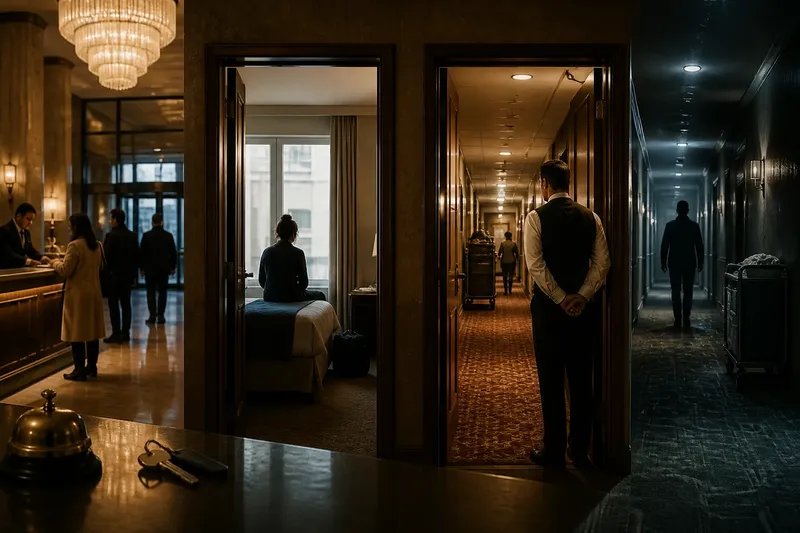
For this invented program, you pick hotels because they combine public and private space. Guests arrive with their own purposes, while corridors, lobbies, and service areas bring strangers into contact. That provides a clear setting to compare without requiring either film to tell a story about travel or hospitality.
Set one practical rule: the place should matter to the film, not merely appear in a passing scene. You might ask whether the characters return to it, whether its layout shapes an important choice, or whether the film’s atmosphere depends on it. If the setting is interchangeable with any other location, keep looking.
Find different roles
Now select films that give the shared place contrasting jobs. One hotel might function as a temporary refuge; another might make privacy feel impossible. A film could treat the lobby as a crossroads where people observe each other, while another turns the building into a secluded world with its own routines.
Genre can help you make the contrast visible. Pairing a comedy with a drama, or a mystery with a romance, may lead to different uses of the same setting. But genre labels are only a starting point: focus on what the hotel makes possible or difficult for the characters, rather than expecting every comedy to feel welcoming or every mystery to feel threatening.
Imagine you choose two hypothetical films. In the first, a traveler uses a hotel as a brief refuge after a difficult family visit; the expected result is that the lobby and guest room feel like separate degrees of privacy. In the second, a hotel employee watches guests come and go while concealing a personal decision; the expected result is that shared corridors feel exposing rather than protective. The stories differ, but the contrast gives your viewing a clear thread.
Plan the viewing order
Decide what you want the first film to establish. If one film makes the hotel feel familiar and socially open, placing it first can make a more isolated or uneasy second film register as a sharp shift. Reversing the order may work better if you want the later film to soften your sense of the place.
Check basic practical matters before inviting people: running time, availability, language or subtitle needs, and whether either film contains material your group would rather avoid. For a mixed group, tell guests the shared-setting idea in one sentence, then let the films speak for themselves. You do not need to supply a lecture or explain the intended contrast in advance.
Keep the break between films short enough that viewers remember specific details, but give people a chance to stretch and talk. A hotel corridor is like a hallway in an apartment building: the same physical passage can feel ordinary, welcoming, or exposed depending on who is present and what the scene asks us to notice. That everyday comparison can help viewers describe their impressions without turning the discussion into a technical test.
Watch the hotel’s role
During each film, notice how the setting directs attention. Does the camera linger on a reception desk, a key, a corridor, or a door left open? Does the sound make the place feel busy or sealed off? These details matter when they shape what you expect from a character or scene.
Also watch how people use the building. A guest may treat the room as a refuge, an employee may regard it as a workplace, and another character may see the lobby as a place to wait for someone. The same location can carry several meanings inside one film, so avoid reducing its role to a single adjective.
Notice what the films leave out, too. One may make service spaces visible; another may keep staff and maintenance offscreen. One may give the audience a clear sense of the building’s layout, while another withholds that orientation. Those choices can change whether viewers feel like observers, guests, or people who have lost their bearings.
Compare without forcing a match
After the second film, begin with concrete observations rather than a verdict. Ask which area of each hotel felt most important, when the setting changed a character’s options, and whether the audience knew more or less than the people inside the story. Then compare answers, allowing viewers to disagree about whether a scene felt secure, lonely, or tense.
In the invented pairing, you might notice that both films use a guest room as a place apart from the public hotel, but for different purposes. In one, privacy lets a character recover; in the other, isolation heightens the cost of a concealed decision. The useful result is not that one film uses hotels better. It is that the shared place makes the films’ different priorities easier to see.
If the comparison seems thin, name what each film uses instead of assuming the pairing failed. Perhaps one emphasizes work and routine while the other emphasizes temporary belonging. That difference can be the discussion’s subject, as long as the setting remains connected to the way each story unfolds.
Questions after viewing?
How similar should the films be?
They need a meaningful setting in common, but their stories can differ widely. A contrast in genre, character, or tone often gives the shared place more to do in your comparison.
Does the place need to be real?
No. A fictional hotel can serve the same purpose if the film establishes it as a place that shapes action or atmosphere. Pay attention to the screen world the film builds, rather than whether you could visit the building.
What if viewers disagree about the setting?
Ask which moment led them to read the place differently. A disagreement can reveal that one viewer noticed a character’s behavior while another focused on framing, sound, or the hotel’s public spaces.
Can the films belong to different genres?
Yes, and that may sharpen the contrast. Choose films whose use of the setting gives viewers something specific to compare, rather than relying on genre labels alone.
A double feature built around one kind of place can turn a familiar setting into a fresh viewing question. For your next double feature, choose the location first, then look for two films that make it serve different purposes; the hotel, station, or school will give you a shared reference point without making the stories repeat each other.